
About Us
Profile of the Insurer
Palladium Insurance Limited (“”Palladium””) is a Guernsey-registered licensed insurer operating under the Insurance Business (Bailiwick of Guernsey) Law, 2002, underwriting After the Event (ATE) legal expenses insurance and Conveyancing Legal Indemnities. Palladium maintains its registered office at Second Floor, Block A, Lefebvre Court, Lefebvre Street, St Peter Port, Guernsey, GY1 2JP. The Insurer operates within the Guernsey regulatory environment under the supervision of the Guernsey Financial Services Commission (GFSC) and is not covered by the UK Financial Services Compensation Scheme (FSCS), reflecting the specific external environment in which it operates. The Company’s objectives include underwriting profitably to enable it to maintain a solvency margin above the minimum required whilst providing an insurance product that meets the needs of its customers.
Corporate Governance
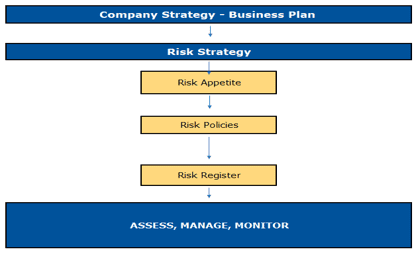
The Company adheres to Appendix 3 of the Finance Sector Code of Corporate Governance, which can be found here. A visual representation of the Company’s Risk Management Framework is as follows:
Technical Reserves
Please refer to the “”Critical Accounting Judgements and Key Sources of Estimation Uncertainty”” note within the Company’s financial statements for details of its approach to technical reserves.
Insurance Risk
Please refer to the “”Insurance and Financial Risk Management”” note within the Company’s financial statements for details of its approach to technical reserves.
Financial Performance
The Company’s financial performance is driven by underwriting activity and investment returns. Earnings are influenced by premium volumes, claims experience, operating expenses, and the management of invested assets. Claims development is monitored to support the assessment of reserving adequacy, while pricing is reviewed to ensure premiums remain sufficient to cover expected claims, expenses, and risk margins. Investment performance reflects a prudent strategy focused on capital preservation and liquidity, consistent with the Company’s risk appetite and regulatory obligations.
Capital Adequacy
Solvency Requirements /Capital Adequacy
As part of its ongoing regulatory obligations, the Company is required to meet certain solvency requirements as laid out in the Insurance Business (Bailiwick of Guernsey) Law, 2002 and underlying rules.
Minimum Capital Requirement
The Minimum Capital Requirement (“MCR”) set at 100% is intended to be the capital required to ensure that a licensed insurer should be able to meet its obligations over the next twelve months with an 85% probability. Further details in relation to the MCR achieved can be found in the notes within the financial statements.
Prescribed Capital Requirement
The Prescribed Capital Requirement (“PCR”) of a retail general insurer set at 135% is intended to be the capital required to ensure that the licensed insurer should be able to meet its obligations over the next twelve months with a 99.5% probability.
Further details in relation to the PCR achieved can be found within the financial statements.
Further information on the MCR and PCR can be found in The Insurance Business (Solvency) Rules and Guidance, 2021 on the Guernsey Financial Services Commission website here.
Financial Instruments
The Company holds a range of financial instruments that are used primarily to support its insurance operations, manage liquidity, and ensure the prudent investment of policyholder and shareholder funds. These instruments are managed in accordance with the Company’s investment policy, which sets out guidelines on credit quality, duration, diversification, and liquidity.
The Company’s investment objectives are to preserve capital, maintain adequate liquidity to meet policyholder obligations as they fall due, and generate stable risk‑adjusted returns. The investment policy is reviewed regularly by the Board to ensure that it remains appropriate to the Company’s risk profile, regulatory environment, and broader risk‑management framework.
Financial instruments are measured in accordance with applicable accounting standards, using valuation methodologies consistent with their classification. For assets measured at fair value, prices are obtained from independent pricing sources where available, with valuation techniques applied where observable market data is not present. The methods and assumptions used for measuring financial instruments for general‑purpose financial reporting are consistent with those used for solvency purposes unless otherwise disclosed.
Further information on the Company’s approach to managing financial instruments can be found within the relevant note to the financial statements.
Enterprise Risk Management and Asset-Liability Management
The Company maintains an integrated Enterprise Risk Management and Asset‑Liability Management framework to identify, monitor and manage the risks arising from its insurance operations and to ensure that policyholder obligations can be met as they fall due. The framework is proportionate to the nature, scale and complexity of the Company’s business and is embedded within governance and decision‑making processes, with oversight provided by the Board through an approved risk appetite. Asset‑liability management focuses on aligning the nature, duration and liquidity of assets with insurance liabilities and monitoring potential mismatches. Where appropriate, the Company holds capital and liquidity buffers in line with its risk profile and regulatory requirements.
A copy of the Company’s Financial Statements can be found here.
Insurance policies are underwritten by Palladium Insurance Limited which is registered in Guernsey and regulated by the Guernsey Financial Services Commission. Palladium Insurance Limited and Palladium Associates Limited both have common ownership.
